Most lawn sprinkler zones should run about 10 to 40 minutes per zone, two or three times a week, but the right number depends on your sprinkler heads, your soil, your grass type, and the season. Spray heads finish fast. Rotor heads need much longer.
At Inspection Gator, we see the fallout from bad watering schedules on Texas properties all the time: soggy soil against the foundation, lawn fungus, and a water bill nobody wants. This guide breaks down exact run times by zone and head type, how much water your lawn actually needs, the best time of day to water, and the warning signs that your schedule is off.
How Long Should Sprinklers Run Per Zone?
There is no single run time for every zone, because your sprinkler heads control how fast the water comes out. Two zones set to the same number of minutes can deliver wildly different amounts of water.
Start with the targets below, then fine-tune each zone.
| Sprinkler head type | How fast does it water? | Run time per zone |
|---|---|---|
| Fixed spray heads | Fast (about 1.5 in/hr) | 10 to 20 minutes |
| Rotor heads | Slower (about 0.5 to 1 in/hr) | 30 to 45 minutes |
| MP rotators | Slow and even (about 0.4 in/hr) | 35 to 45 minutes |
| Drip or micro-spray (beds) | Very slow | 30 to 60 minutes |
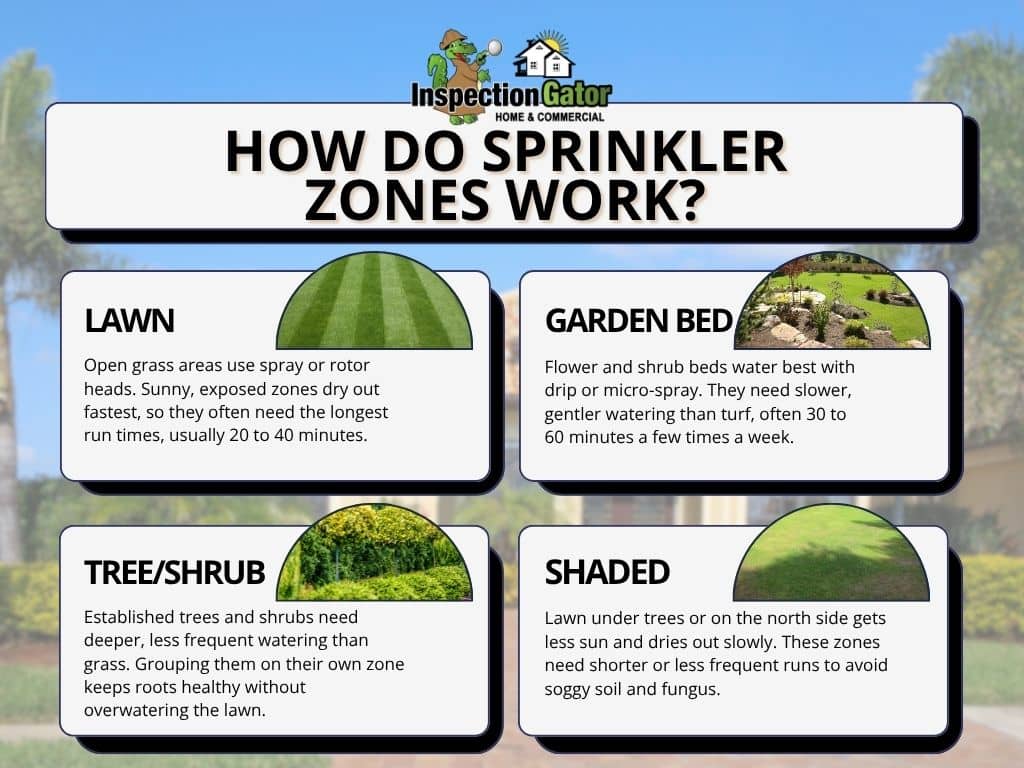
All zones are not equal, either. A sunny zone along a south-facing wall dries out faster than a shady zone under trees, so it needs a longer or more frequent run. Zones on a slope lose water to runoff, and zones over heavy clay soil cannot absorb water quickly.
For those zones, the smarter fix is not a longer single run. It is the cycle-and-soak method covered in the next section.
How Much Water Does Your Lawn Actually Need?
Most lawns need about 1 to 1.5 inches of water per week, including rainfall. That weekly total matters far more than the minutes on your timer, so the goal is to hit roughly 1 inch and let the heads decide how long that takes.
The easiest way to measure is a catch-can test. Set three or four straight-sided containers (empty tuna cans work) around a zone, run it for 15 minutes, then measure the water in each. If you collected a quarter inch in 15 minutes, that zone delivers about 1 inch in an hour, so two 30-minute sessions a week get you there. You can read more on efficient watering targets through the EPA’s WaterSense lawn watering guidance.
If your zone runs off into the street or sidewalk before it finishes, switch to cycle-and-soak. Instead of one long run, water in two or three shorter cycles with a 30 to 60-minute pause between them. The pause lets the water soak in so the next cycle is not wasted. This is especially important on the heavy clay soils common across much of Texas, where a single long run sheds off the surface long before the roots get a drink.
Run Times by Grass Type and Soil
Your grass and your soil change the math. Match your run time to both.
| Lawn type | Run time per zone | Frequency |
|---|---|---|
| Warm-season (Bermuda, St. Augustine, Zoysia) | 15 to 25 minutes | 1 to 2 times per week |
| Cool-season (tall fescue, ryegrass) | 20 to 30 minutes | 2 to 3 times per week |
| Garden beds and shrubs | 15 to 20 minutes | 2 to 3 times per week |
Most Texas lawns are warm-season grasses, which handle heat well and prefer deep, infrequent watering. For region-specific turf advice, the Texas A&M AgriLife Extension turf program is a strong, local resource.
Soil decides how long water stays available to the roots:
-
- Sandy soil drains fast, so water for shorter periods but more often.
-
- Clay soil holds water and resists absorption, so water less often but use the cycle-and-soak method to avoid runoff.
-
- Loam sits in the middle and is the most forgiving.
Best Time of Day and Seasonal Adjustments
Water early in the morning, between 4 and 10 a.m. At that hour, there is little wind and almost no evaporation, so more water reaches the roots. The grass blades also dry out during the day, which lowers the risk of lawn fungus.
Watering at midday wastes water to evaporation, and watering in the evening leaves the lawn wet overnight, which can increase the risk of disease.
Your schedule should shift with the seasons:
-
- Summer: The hottest, driest stretch needs the most water, often two or three sessions a week in the Texas heat.
-
- Spring and fall: Dial back as temperatures drop and the lawn grows more slowly.
-
- Winter: Many lawns need little to no supplemental watering. A rain sensor or smart controller pays for itself here.
Always check local watering rules before you set a schedule. Many Texas cities limit watering days and hours, especially during drought. Confirm what applies to your address through your city or water utility, or review the state’s outdoor watering and irrigation rules.
Signs You’re Watering Too Long or Not Enough
Your lawn tells you when the schedule is wrong. Watch for these.
You’re watering too long if you see:
-
- Spongy, squishy soil that stays wet a day after watering
-
- Runoff onto the sidewalk or street while the zone is still running
-
- Mushrooms, or fungus, and spreading brown patches in the lawn
-
- More gnats, mosquitoes, and other pests are drawn to standing water
-
- Water spraying against the house or pooling near the foundation
That last one matters most on a Texas property. Constant moisture against the slab can shift expansive clay soil and contribute to foundation cracks, and water that wicks into siding or crawl spaces can lead to a mold problem. If you have already dealt with one, the steps for what happens after mold remediation are worth knowing, whether moisture intrusion is active or not. Chronically damp wood around a home also creates the conditions that attract the wood-eating insects found in Texas homes.
You’re not watering enough if you see:
-
- Footprints that stay pressed into the grass instead of springing back
-
- A dull blue-gray tint instead of healthy green
-
- Dry, crunchy blades and soil that is hard to push a screwdriver into

Related Questions to Explore
How long should sprinklers run in each zone?
It depends on the head type in that zone. Fixed spray zones need about 10 to 20 minutes, while rotor zones need 30 to 45 minutes to deliver the same amount of water. Run a catch-can test per zone to dial it in.
Can a sprinkler system damage your home’s foundation?
Yes. Heads that spray toward the house or zones that pool water near the slab keep the surrounding soil wet, and on the expansive clay common across Texas, that moisture makes the soil swell and shift. Over time, that movement can contribute to foundation cracks. Aim sprinklers away from the structure and keep the soil moisture around the perimeter as even as possible.
Does a home inspection check the irrigation or sprinkler system?
Standard home inspections generally note visible drainage issues, grading concerns, and signs of moisture intrusion. Some inspectors will operate readily accessible irrigation systems, but a full sprinkler system evaluation is typically performed by a licensed irrigation professional.
Can overwatering lead to mold or moisture problems indoors?
It can. Water that sprays against siding or collects near the foundation can wick into walls, crawl spaces, and slabs, creating the damp conditions mold needs to grow. If you smell must or see staining after a stretch of heavy watering, a mold and/or air quality inspection can confirm whether moisture intrusion is active.
How far should sprinkler heads be from the house?
Keep heads angled so spray lands on the lawn, not the walls, and position perimeter heads so water falls at least a few feet out from the foundation. Pairing that with good grading, where the ground slopes away from the home, keeps irrigation water from working against the structure.
When to Call a Professional
Call an irrigation pro when adjusting the schedule does not fix the problem. Broken or clogged heads, zones that will not shut off, uneven coverage with dry and soggy patches, and a sudden jump in your water bill all point to a system issue rather than a timer setting. An irrigation audit will catch leaks and coverage gaps you cannot see from the surface.
The watering schedule also matters when you buy or sell a home. A thorough home inspection looks at how water moves around the property, including grading, drainage, and signs of moisture intrusion near the foundation, which is exactly where a bad sprinkler setup shows up.
If you are building, our new construction phase inspections catch drainage and grading problems before they are buried in landscaping. Inspection Gator serves homeowners and buyers across our service area.
Conclusion
Getting your sprinkler run times right protects your lawn, your foundation, and your water bill at the same time. Keep three things in mind:
-
- Match run time to your head type: spray zones 10 to 20 minutes, rotor zones 30 to 45 minutes, aiming for about 1 inch of water a week.
-
- Water early in the morning and adjust by season, using cycle-and-soak on clay or slopes.
-
- Watch for runoff, fungus, and water against the foundation as your signal to cut back.
Worried that overwatering has already caused damage around your home? Schedule a home inspection with Inspection Gator, and we will check the grading, drainage, and moisture conditions that a sprinkler problem leaves behind.