Buying a new build home feels different from buying a resale. The floors are clean, the paint is fresh, and every appliance looks like it came out of the box yesterday. It is easy to assume everything is in perfect shape because nothing has been lived in yet. The reality is that new construction homes can have just as many issues as older ones, sometimes more, because problems get hidden behind finished walls before anyone catches them.
Whether you are building in Texarkana, moving to a new subdivision in Tyler, or closing on a spec home outside Idabel, this checklist will walk you through what to look for at every stage. Spotting issues early is much cheaper than fighting with a builder after you move in.
Why a New Build Home Buyer Still Needs a Checklist
New construction is built fast, even with the best builders working with a rotating crew of subcontractors, tight deadlines, and weather delays. Small details get missed. Materials show up damaged. Inspections from the city or county confirm code compliance, but they do not catch every cosmetic flaw, installation mistake, or structural concern.
A checklist gives you a structured way to walk through the home and flag problems while the builder is still on the hook to fix them. It also creates a record. If something falls apart six months after closing, you have notes, photos, and dates showing what the home looked like at handoff.
This is where third-party phase inspections become one of the smartest investments you can make for your new construction. A licensed inspector looks at the home at key build stages and again before closing, finding things most buyers would never notice on their own.

The Three Key Phases of a New Build Inspection
Most buyers think of a home inspection as a single event at the end. For new construction, the best approach is to break it into phases so you can catch different kinds of issues before they get covered up.
Your inspector will check all of these points for you, but it’s also important to be familiar with the scope yourself. An informed buyer is much less likely to end up with surprises or problems down the road
Phase 1: Pre-Pour or Foundation Inspection
Before the concrete slab is poured, an inspector can look at the framework, rebar placement, plumbing rough-ins, and grading. Once concrete goes down, fixing foundation issues becomes expensive or impossible.
This phase matters most in expansive clay soil areas common across East Texas, where poor preparation can cause cracking and movement within a few years.
Phase 2: Pre-Drywall Inspection
After framing, plumbing, electrical, and HVAC rough-ins are in but before drywall hides everything, this is your last clear look at the bones of the house.
The inspector checks framing, structural connections, plumbing, and electrical routing, duct sealing, insulation, and flashing.
Phase 3: Final Walkthrough Inspection
This is closest to a traditional home inspection. The inspector evaluates every finished system: roof, exterior, windows, doors, interior finishes, appliances, HVAC, plumbing, and electrical.
Anything not working correctly goes on a punch list for the builder to address before closing.
Your New Build Home Checklist by Area
Use this checklist during your walkthrough or alongside your inspector. It will not replace a professional evaluation, but it helps you stay organized and ask better questions.
Exterior
- Siding is flat, flush, and properly caulked at seams
- No gaps or exposed wood around windows and doors
- Roof shingles lie flat with no lifted edges or exposed nails
- Gutters slope toward downspouts and discharge away from the foundation
- Grading slopes away from the house on all sides
- Driveway and walkways are free of major cracks
- Hose bibs, outdoor outlets, and AC disconnects are installed and functional
Foundation and Grading
- No visible cracks wider than a hairline
- Weep holes in the brick veneer are clear
- Soil does not touch the siding or the bottom of the brick
- Downspouts extend at least 4 to 6 feet from the foundation
Roof and Attic
- Flashing is installed at chimneys, vents, and valleys
- Ridge and soffit vents are present and not blocked
- Attic insulation is evenly distributed at the correct depth
- No daylight visible through the roof deck
- Bathroom and dryer vents exit through the roof or wall, not into the attic
Plumbing
- All faucets run hot and cold with no sputtering
- Drains empty quickly with no gurgling
- Toilets flush and refill properly
- Shower valves hold temperature under load
- No leaks under sinks, around tubs, or at water heater connections
- Water pressure feels consistent across the house
Electrical
- All outlets are powered and properly grounded
- GFCI outlets trip and reset in kitchens, bathrooms, garages, and exteriors
- Switches control the correct lights and fixtures
- The breaker panel is labeled
- Smoke and carbon monoxide detectors are installed and operational
HVAC
- System cools and heats evenly across all rooms
- Vents blow strongly in every room
- The thermostat responds correctly to temperature changes
- The filter is clean and installed in the right direction
- Condensate drain is clear and properly routed
Interior Finishes
- Walls are smooth with no visible seams, bulges, or nail pops
- Paint coverage is even with no obvious touch-ups
- Flooring is flat, tight, and free of gaps or squeaks
- Tile grout lines are uniform and sealed
- Cabinet doors and drawers open, close, and align correctly
- Countertops are level, sealed, and free of chips
Windows and Doors
- Every window opens, closes, and locks smoothly
- Screens are present and undamaged
- Exterior doors seal fully with working weatherstripping
- Interior doors close without rubbing or gaps
Appliances
- Each appliance powers on and runs through a full cycle
- The oven heats accurately against a thermometer
- Dishwasher drains fully with no leaks
- Refrigerator ice maker and water line work
- Garage door opener, remotes, and safety sensors work
Common Issues Found in New Build Homes
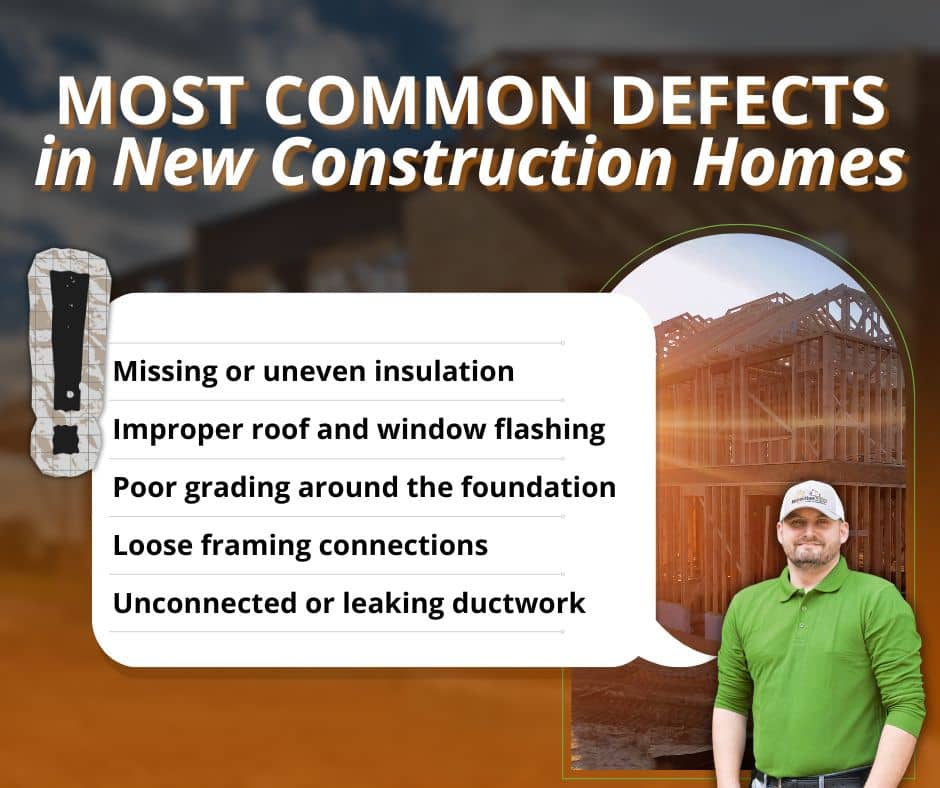
Even in brand new homes across NE Texas, SW Arkansas, and SE Oklahoma, certain problems come up over and over. Knowing what to look for helps you spot them faster.
| Issue | Where It Shows Up | Why It Matters |
| Missing insulation | Attic, exterior walls | Higher energy bills, temperature swings |
| Improper flashing | Roof, windows, doors | Water intrusion, future mold issues |
| Reversed hot/cold lines | Sinks, showers | Plumbing rework required |
| Loose or missing fasteners | Roof decking, framing | Structural weakness |
| Poor grading | Around foundation | Water pooling, foundation movement |
| Unconnected ducts | Attic, crawlspace | Wasted energy, uneven cooling |
| Cracked tile or grout | Bathrooms, kitchens | Cosmetic and water damage concerns |
| Faulty GFCI outlets | Bathrooms, kitchens, exterior | Shock hazard |
Every one of these shows up regularly in otherwise beautiful new homes. An experienced inspector knows exactly where to look because they have seen the same mistakes hundreds of times.
What to Do With Your Inspection Findings
Once your checklist is complete and your inspector has delivered their report, the next step is turning it into action.
- Share the report with your builder and ask for a written response to each item
- Prioritize safety and structural issues first, then systems, then cosmetic concerns
- Get repair confirmations in writing, including what was done and when
- Schedule a re-inspection before closing if major items were corrected
- Hold onto your report for future reference, especially during your one-year builder warranty walk
Builders in Texarkana, Tyler, and across NE Texas often honor a one-year warranty, so the first anniversary of closing is another great checkpoint for a fresh inspection. Many issues only show themselves after the home has gone through a full seasonal cycle.
Related Questions to Explore
Do I really need a home inspection on a brand new home? Yes. Municipal inspections check compliance, not workmanship or long-term performance. A third-party new construction inspection catches the details that your builder’s team and the city do not.
When is the best time to schedule a new construction phase inspection? Ideally, at three points: before the foundation is poured, after framing and rough-ins, but before drywall, and during the final walkthrough. Even one of the three is better than none.
Should a sewer scope or septic inspection be part of a new build inspection? Absolutely. New lines can still have construction debris, damaged pipe, improper slope, or separated joints from heavy equipment traffic during the build.
Is a termite inspection necessary on new construction? In Texas, a WDI (wood-destroying insect) report is often required for financing, and it is smart to add it regardless. Termite pretreatment is common in new builds, but it needs to be verified and documented. Learn more about termite inspections and treatment from The Xtermigator!
When to Call a Professional
Some new build concerns are easy to spot on your own. Others hide in places only a trained inspector knows to look. Consider calling a licensed home inspector if:
- You are buying or building a new construction home, regardless of the builder’s reputation
- The home has been through major weather events during construction
- You have concerns about foundation prep, framing, or hidden systems
- Your builder is resistant to answering questions or addressing punch list items
- You want a paper trail before your one-year warranty expires
Inspection Gator offers new construction phase inspections, final walkthrough inspections, mold and air quality testing, sewer scopes, well and septic evaluations, and termite inspections across NE Texas, SW Arkansas, and SE Oklahoma. Having one trusted team handle every piece of your new home inspection keeps the process simple and the findings consistent.
Conclusion
A new build home is a huge investment, and a checklist is one of the easiest ways to protect it. Walking through each area with a clear plan, asking the right questions, and getting a third-party inspector involved at the right stages gives you confidence that the home was built the way it should be.
If you are getting ready to close on a new construction home anywhere across NE Texas, SW Arkansas, or SE Oklahoma, the team at Inspection Gator would love to help you feel fully informed before you sign.